755 vs 808 vs 1064 nm Diode Lasers: A Buyer's Guide
Compare 755, 808 and 1064 nm diode laser labels, source types and wavelength packages. Learn what clinics and distributors should confirm before ordering.
An equipment quotation headed “755 / 808 / 1064 nm” leaves an important purchasing question unanswered: what laser source and wavelength configuration will actually arrive? For a clinic or distributor, that distinction affects the documents, operator training and product descriptions needed after delivery.
This guide compares wavelength labels for professional diode laser hair-removal equipment. It does not prescribe treatment settings or rank a wavelength as suitable for every patient.
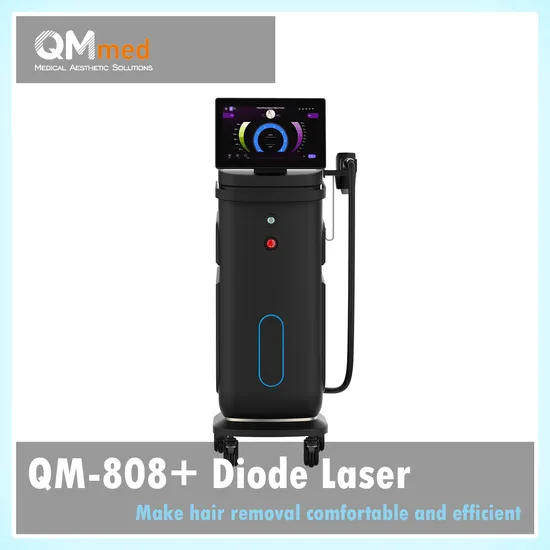
Machine pictured: the QM-808+ vertical diode laser platform, using our existing confirmed product photograph. The photograph identifies the machine; it does not verify the wavelength package inside a particular order.
Read the wavelength and the laser type together
Nanometres describe the wavelength of the emitted light. “Diode”, “Alexandrite” and “Nd:YAG” describe different laser technologies. A matching number does not make the sources interchangeable.
A diode laser generates light in a semiconductor. A 755 nm diode component is therefore not an Alexandrite crystal laser, and a 1064 nm diode component is not an Nd:YAG crystal laser. For comparison, Candela's original GentleMax Pro brochure identifies its two laser types separately as Alexandrite and Nd:YAG, alongside their respective 755 and 1064 nm wavelengths. Those technology descriptions cannot be transferred to a diode machine merely because the wavelength numbers match.
This matters when reviewing research or writing a distributor catalogue. Evidence from a named Alexandrite or Nd:YAG device does not automatically establish the performance of a diode platform sold with the same nominal wavelength.
| Label on a diode quotation | What it tells a buyer | What still needs confirmation |
|---|---|---|
| 755 nm | A stated diode wavelength shorter than 808 and 1064 nm | Whether it is supplied, its contribution to a mixed output, and the device-specific intended use |
| 808 nm | A commonly supplied wavelength for diode hair-removal equipment | Whether the order is 808-only or includes other emitting components |
| 1064 nm | A stated longer diode wavelength; not a declaration of an Nd:YAG source | The actual source specification and whether that component can operate separately |
Separate a wavelength list from wavelength control
A handpiece may contain more than one emitting wavelength. That alone does not tell a buyer whether the components operate together, whether their relative contributions are fixed, or whether the operator can select each one independently.
Coherent's diode-laser white paper explains semiconductor wavelength generation and discusses balancing output across different diode materials. It illustrates why the source design matters as well as the list of wavelengths. This is component-level background, not evidence that a particular component supplier is fitted in a ZENLASE machine.
Before approving a multi-wavelength quotation, ask for three connected items:
- A configuration sheet identifying the exact model, hardware version, handpiece and supplied wavelengths.
- A description of the emission arrangement: combined output, separately selectable wavelengths, or another documented design.
- A matching manual and, where available, an output verification record identifying the measurement method and conditions.
Do not assume an equal energy split between wavelengths. A touch-screen label or a photograph of the enclosure cannot establish that split. If independent wavelength selection is essential to your purchasing brief, make it an explicit acceptance requirement rather than inferring it from “three wavelengths”.
Why a wavelength label cannot select patients
Hair-removal systems use absorption of light by pigment to create a thermal effect. The foundational selective-photothermolysis paper by Anderson and Parrish describes how optical absorption and pulse timing contribute to selective thermal effects. It is a physical principle, not a clinical validation of any machine pictured here.
Patient assessment remains separate from equipment procurement. The American Academy of Dermatology's laser hair-removal guidance identifies hair colour and thickness, the treated area, laser type and skin colour as factors affecting results, and explains that burns, pigment changes and scarring can occur.
For a buyer, the practical question is whether the exact device has appropriate instructions, intended-use documentation and training for the proposed service and destination. Adding wavelengths does not prove suitability for every skin phototype, remove thermal risk or guarantee a treatment outcome. A clinic's qualified practitioner must assess suitability and follow the applicable device instructions and local requirements.
Apply the distinction to a QM-808+ enquiry
The current QM-808+ product page lists 808 nm and a 755 + 808 + 940 + 1064 nm option in its wavelength field. That wording describes alternatives to confirm; it does not mean every QM-808+ ships with every wavelength, or that the listed components are independently selectable.
Keep that configuration enquiry separate from QM-808A. The model suffix is part of the identity, and a different model's options should not be copied into its order record. Likewise, a photograph confirms the depicted exterior, not the installed optical package or the documents available for a destination market.
Use our diode laser equipment buying guide to shortlist the machines. For the meanings of power, fluence, pulse duration and repetition rate, see the separate diode laser specification guide. Those quantities need their own definitions; they are not shortcuts for choosing a wavelength.
Put the wavelength package into the order description
An enquiry can be concise: “Please quote the QM-808+ for our destination and intended professional use. Identify the supplied wavelength package, whether the wavelengths operate together or separately, the included handpiece, the matching manual and the available model-specific documents. List optional configurations separately.”
ZENLASE is our factory's international sales team. Send your exact model, quantity, destination and configuration questions through the quotation form. The useful comparison is between documented configurations you can order and support, rather than wavelength counts alone.