Diode Laser Specifications Explained: W, J/cm², ms and Hz
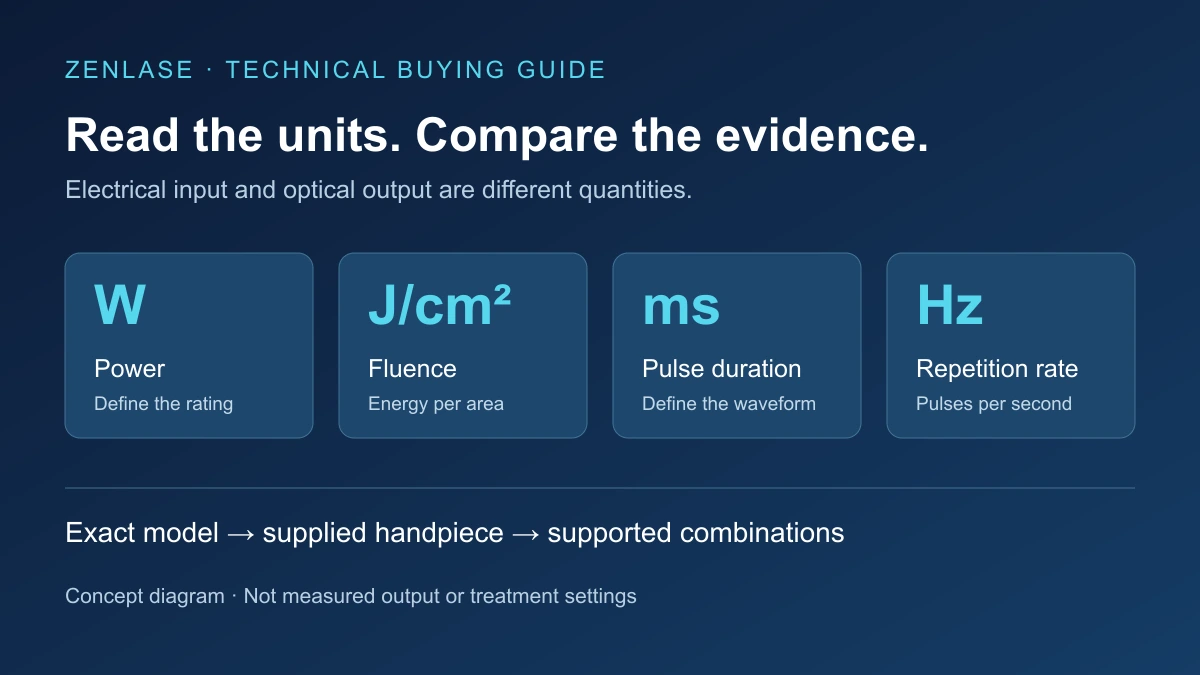
Understand power ratings, fluence, pulse duration and repetition rate before comparing diode laser equipment. Learn which configuration and measurement details to request.
A diode laser specification sheet can list watts, joules per square centimetre, milliseconds and hertz beside one another. Those numbers describe different things. A larger watt figure alone cannot tell a buyer how much optical energy reaches the handpiece exit, which settings can run together or what is included in a quotation.
This guide explains the units and the evidence to request when comparing professional hair-removal equipment. It is a technical purchasing guide, not a treatment protocol.
First identify what the watt rating describes
Electrical input is the power drawn from the electrical supply. A power-supply rating describes an electrical component. Optical output is the light emitted at a specified measurement point. All may be expressed in watts, but they are not interchangeable.
When a brochure says “laser power”, ask whether it means a diode-stack rating, measured optical output, average output during a pulse train or another value. Request the measurement location and operating conditions. A rating at the source does not by itself establish the output at the handpiece exit.
For the QM-808+ configuration page, the field named “Laser Power Supply” should be read as that field, rather than silently relabelled as measured optical output. Keep QM-808A and other exact model identifiers in separate comparison records.
J, J/cm², ms and Hz answer different questions
Pulse energy, measured in joules (J), is the optical energy in one pulse. Fluence, measured in J/cm², expresses that energy relative to an illuminated area. The area definition matters: ask whether the figure uses the stated treatment window, a measured beam area or another convention. An average over an area does not describe every point in a non-uniform beam.
Pulse duration, commonly stated in milliseconds (ms), describes the time scale of a pulse. Ask how the duration is defined and whether the selected mode uses a single pulse or a sequence of sub-pulses. A displayed time alone does not describe the full pulse shape.
Repetition rate, measured in hertz (Hz), tells you how many pulses occur per second. It does not state the energy in each pulse. Confirm whether increasing the rate changes the available pulse energy, duration or cooling requirements.
How the quantities connect
For a repeating sequence of equal-energy optical pulses, average optical power equals pulse energy multiplied by repetition rate. The definitions and relationships are explained in Newport’s Average and Peak Power technical note.
Fluence is pulse energy divided by the specified illuminated area. Edmund Optics’ guide to laser power density and energy density distinguishes the corresponding units. Neither calculation converts electrical input into measured optical output.
Pulse energy divided by duration gives the mean power over that defined pulse interval. It equals peak power only for an ideal rectangular pulse; for other pulse shapes, the peak depends on the waveform. Do not treat a calculated value as a measured equipment specification.
These relationships help you ask consistent questions. They do not establish safe settings, clinical suitability or expected results.
Compare combinations, not separate maxima
A specification may give a maximum repetition rate, a maximum fluence and a maximum pulse duration without stating whether all three are available simultaneously. Ask for the supported combinations for the supplied handpiece, spot and operating mode.
A useful written confirmation identifies:
- The exact model, hardware version and handpiece.
- The wavelength package and the basis of each power rating.
- The spot dimensions and area convention used for fluence.
- The pulse-duration definition, pulse mode and permitted repetition rates.
- Any output limits when a different spot, mode or rate is selected.
- The applicable measurement conditions and available verification record.
For spot dimensions, preserve both sides of a rectangular window rather than replacing them with one diameter. Do not assume two differently shaped windows have the same area, or that a larger window automatically delivers the same fluence.
Cooling descriptions need their own context
A contact-tip temperature, a circulating-water temperature and room temperature refer to different locations. Ask where a quoted temperature is measured, whether it is a setpoint or measured value, and under what load and ambient conditions it applies. A cooling number alone does not establish treatment safety or continuous-duty performance.
Request the maintenance requirements for the supplied configuration, including the specified coolant or water, filters, cleaning and service intervals. Use the actual manual rather than borrowing instructions from a visually similar machine.
Turn the specification into a verifiable order
Ask for one configuration sheet linking the model, handpiece, included accessories, parameter definitions and applicable operating manual. Keep optional components separate from the standard delivery list. Where two documents disagree, get the difference resolved before ordering instead of combining the most attractive figures from each.
ZENLASE is our factory’s international sales team. We can prepare a model-specific configuration quotation and arrange standard equipment training. Share the model, quantity, destination and the specification points you want clarified through our quotation form.
For a structured comparison, use the diode laser equipment buying guide and the equipment quotation checklist. Treatment selection and operating settings must follow the supplied equipment instructions and appropriately qualified professional assessment.